
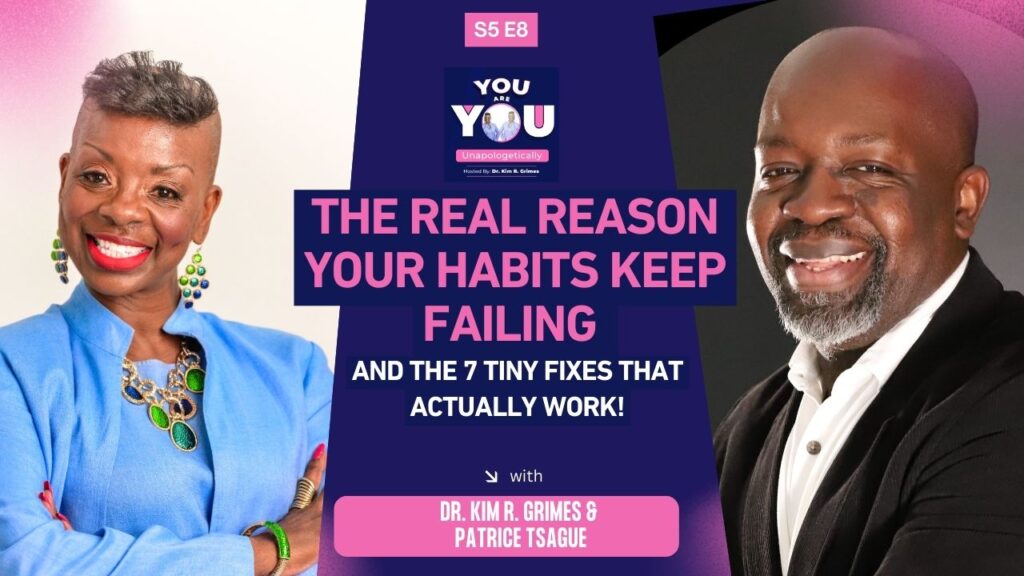
What if your habits are not failing because you lack discipline?
What if the real problem is that the strategy you have been using was never designed for a real person living a real life?
In this powerful episode of You Are You Unapologetically, Dr. Kim R. Grimes opens up a freeing and practical conversation about habit failure, self-blame, and what it really takes to build sustainable consistency. Joined by Patrice Tsague, this episode breaks down why so many people keep starting over and how small, compassionate changes can create real momentum.

I’m Dr. Kim R. Grimes, relationship expert, speaker, author, and founder of You Are You Unapologetically, a movement dedicated to helping women embrace their true identity, heal deeply, and live boldly without shrinking.
For over two decades, I’ve worked with women from all walks of life, high achievers, leaders, professionals, mothers, dreamers, who look confident on the outside but are silently questioning their worth, their voice, and their value. My mission is simple: to help you stop settling, stop performing, and start living in alignment with who you truly are.
My work centers around self-worth, healthy relationships, emotional healing, authentic confidence, and spiritual growth. I believe love should never require you to abandon yourself, and confidence should never require you to become someone else.
Through my podcast, coaching, speaking engagements, and educational programs, I create safe but transformative spaces where women can confront truth, set standards, build boundaries, and reclaim their power, unapologetically.
At my core, I believe this:
No one is better at being you than you.

Why This Conversation Matters
Too many people carry shame around inconsistency.
They start with good intentions.
They make plans.
They feel motivated.
And then life interrupts.
Schedules change.
Energy shifts.
Responsibilities pile up.
And the habit quietly disappears.
What often comes next is self-criticism.
People start telling themselves they are lazy, inconsistent, undisciplined, or bad at follow-through. But this episode makes one thing clear: most habits do not fail because something is wrong with you. They fail because the system was never supportive enough to help you succeed in real life.

Patrice Tsague is a seasoned entrepreneur, international speaker, best-selling author, and kingdom business coach who began his entrepreneurial journey at age 19. He is known for helping individuals and families build businesses rooted in faith, values, and long-term sustainability. As co-founder of several for-profit and nonprofit ventures, including the Nehemiah Entrepreneurship Community and Smart Optimal Solutions, he has trained more than 25,000 people worldwide and helped clients generate over $200 million in revenue while creating jobs. Patrice is also the author of several books on biblical entrepreneurship and business leadership, serves as Chief Servant Officer of Nehemiah Entrepreneurship Community and CEO of SOS America, teaches entrepreneurship at George Fox University and Portland Bible College, and serves on multiple nonprofit and business boards.
Please watch the Episode Here
Listen To the Episode Here
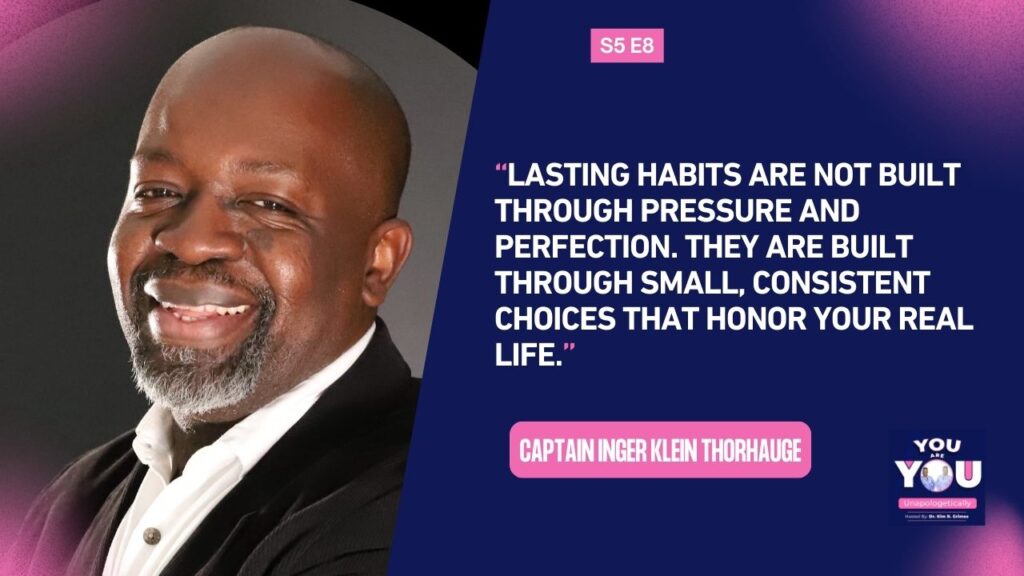
The Real Reason Habits Fail
This episode does not frame habit failure as a willpower problem.
It reframes it as a strategy problem.
Dr. Kim highlights that habits are not only about motivation. They are deeply connected to identity, environment, emotional safety, and self-trust. That means when a habit is not working, the answer is not always to push harder. Sometimes the answer is to become more honest about what actually supports your life, energy, and growth.
That shift alone is powerful.
Because when you stop treating yourself like the problem, you finally create room for real progress.
The All-or-Nothing Trap
One of the most important themes in this episode is the danger of perfectionism.
So many people believe that missing one day means they have ruined everything. They fall into an all-or-nothing mindset where one missed workout, one skipped prayer, one late morning, or one imperfect week feels like total failure.
But perfectionism is one of the fastest ways to destroy consistency.
Why?
Because it turns growth into pressure.
It makes normal human interruptions feel like personal failure.
And it convinces people to quit instead of adjust.
This episode reminds listeners that missing a day does not mean you failed. It means you are human.
Identity Shapes What Sticks
Another major insight in this conversation is the role of identity in habit formation.
There is a big difference between saying:
“I’m trying to be consistent.”
And saying:
“I’m someone who shows up.”
That shift matters.
Because habits become stronger when they are connected to who you believe you are becoming. When your actions are rooted in identity, they stop feeling like random tasks and start feeling like alignment.
Consistency is not just about checking a box.
It is about becoming someone you trust.
The 7 Tiny Fixes That Actually Work
This episode is especially refreshing because it does not push extreme overhauls or unrealistic routines. Instead, it points listeners toward small, compassionate, sustainable adjustments.
Here are seven tiny fixes pulled from the heart of the conversation:
1. Make the habit smaller
If the habit feels too heavy, too big, or too hard to maintain, shrink it. Smaller habits are easier to repeat, and repetition builds momentum.
2. Stop using perfection as the standard
Progress does not require flawless execution. A habit can still be working even if it does not happen perfectly every day.
3. Build from identity, not pressure
Choose language and routines that reinforce who you are becoming, not just what you are trying to force yourself to do.
4. Adjust your environment
Your environment either supports your habits or works against them. Set up your surroundings to make consistency easier.
5. Use support, not shame
Growth works better when it feels safe. Criticism may create short bursts of pressure, but compassion builds long-term consistency.
6. Rebuild self-trust slowly
If you have started and stopped many times, begin with promises small enough to keep. Trust is rebuilt through repeated honesty with yourself.
7. Let your system fit your real life
A habit is more likely to stick when it honors your responsibilities, energy, and actual rhythm of life instead of some unrealistic ideal.
Environment and Self-Trust Matter More Than People Realize
This episode also highlights two overlooked pieces of habit success: environment and self-trust.
Environment matters because habits do not happen in isolation. Your physical space, routines, cues, and daily setup all influence whether consistency feels natural or exhausting.
Self-trust matters because every time you promise yourself something and do not follow through, it affects how you see yourself. That is why habit change is not only behavioral. It is emotional.
The goal is not just to build a new routine.
The goal is to become someone who feels safe trusting herself again.

Key Takeaways from This Episode
This conversation leaves listeners with several strong reminders:
Habit failure is usually a strategy issue, not a character flaw.
Perfectionism destroys progress.
Identity shapes behavior.
Tiny fixes create lasting momentum.
Consistency grows through compassion, not pressure.
The truth is simple and freeing:
You are not broken.
You just need better systems.
A Gentle Challenge for This Week
At the end of the episode, listeners are encouraged to take three simple steps:
Choose one habit and make it smaller.
Adjust your environment to support it.
Speak to yourself with encouragement instead of criticism.
That is where sustainable growth begins.
Not in shame.
Not in force.
But in support.
Final Thoughts
In a world full of pressure to do more, be more, and prove more, it is easy to think your struggle with habits means you are failing.
But you were never meant to grow through shame.
You were meant to grow through awareness.
Through support.
Through grace.
Through systems that honor your humanity.
So stop starting over from a place of frustration.
Start supporting yourself from a place of wisdom.
Because the life you are building does not need harsher pressure.
It needs gentler structure.
And that is how real consistency begins.